Clues You Can Hold: Coriolis at Origins
Content note: This post discusses specific scenes, props, and reveals from The First and Last Man, the opening adventure of The Flowers of Algorab for Coriolis: The Great Dark. If you plan to play it and want to arrive at the table without knowing what waits there, you may want to skip ahead.
This was my second year at Origins, and it remains my favorite convention. A little less than twenty thousand people, which is the sweet spot. Large enough to be a real show, small enough that you can move through the vendor hall without a single “excuse me.” The hotels are attached to the space, so once you are settled, the whole convention is a short walk away. You could spend five days doing nothing but sitting down at demo tables, and a fair number of people do exactly that. It has the scale of a major convention without the crush of one.
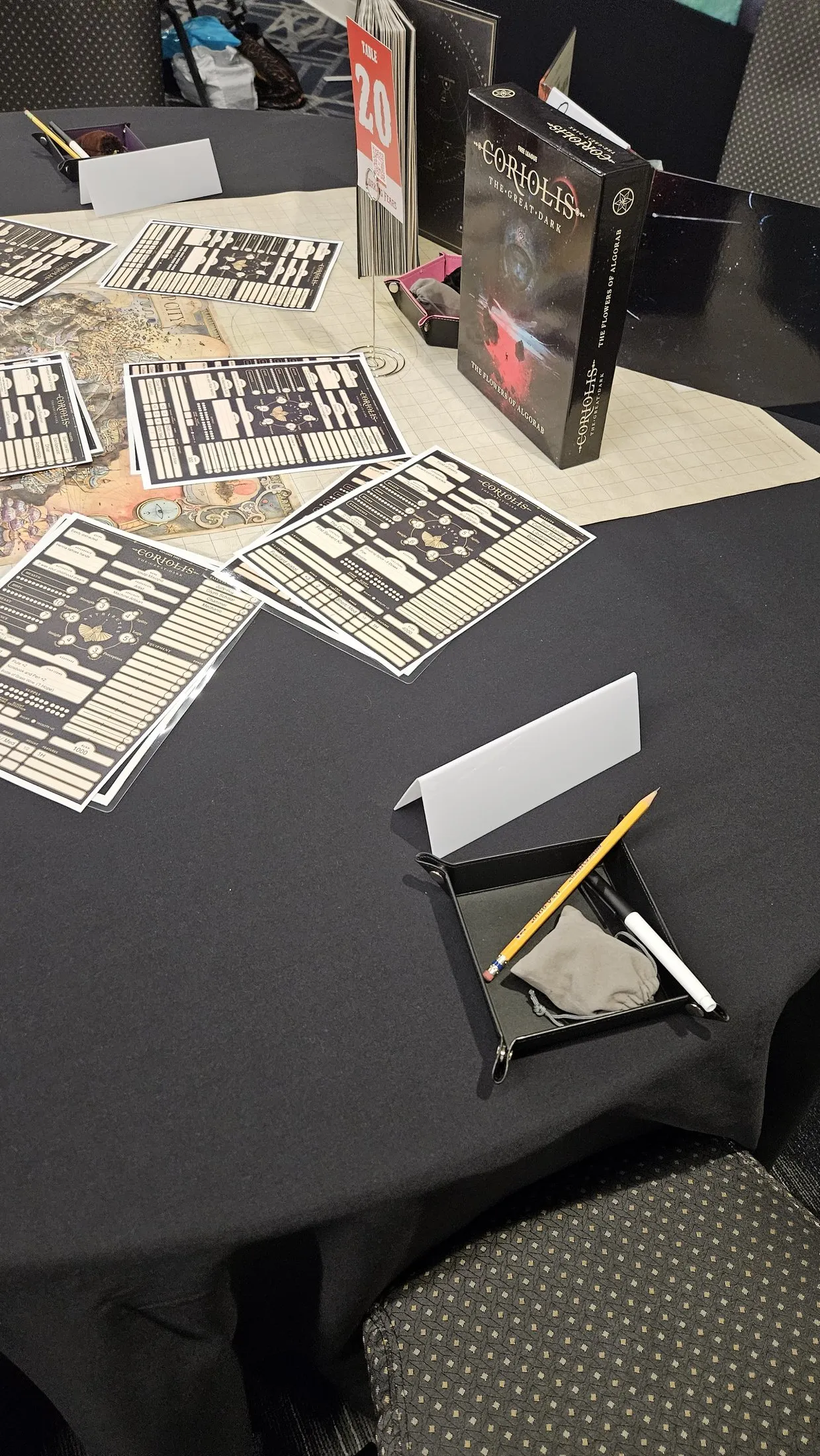
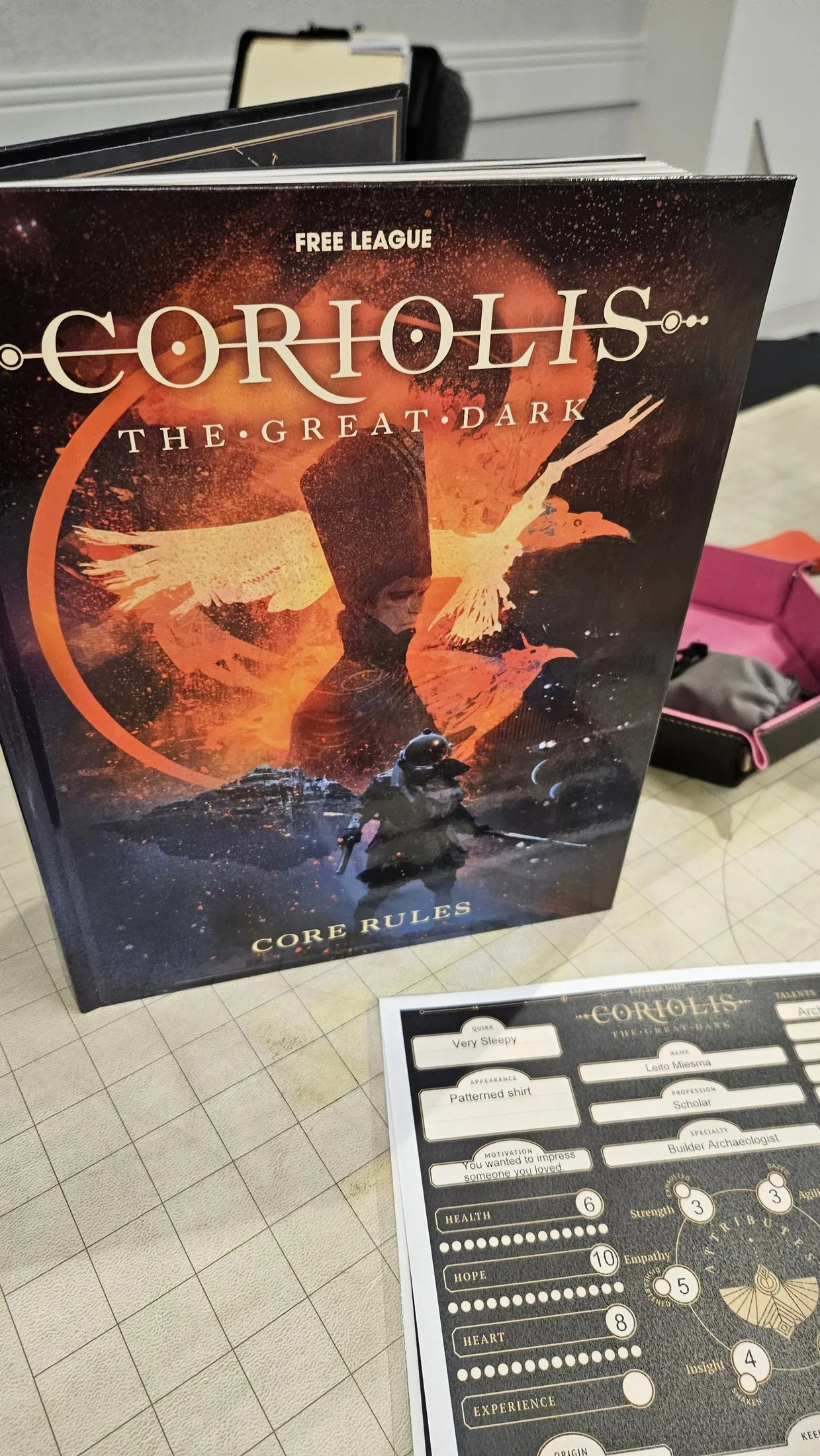
I spent my Origins behind the screen, running games under the Lurking Fears banner. Alongside my Cosmere RPG tables, I ran three sessions of The First and Last Man, the opening adventure of The Flowers of Algorab. That is the first full campaign for Coriolis: The Great Dark, the new science fiction game from Free League. Two of my tables sat five players, and one sat four.
A world I had to build first
If you have read my Cosmere post, this was the mirror image of it. At those tables, most players already knew the fiction and were learning the system. Here it was reversed. A few of my players had the books, but most were arriving in the Third Horizon cold. So before anyone rolled a die, I spent real time at the front of each session building the world for them. The diaspora. The long journey out. What Ship City is, and why people live the way they do inside it. You cannot investigate a place you cannot picture, so I gave them the place first.
What I did not have to teach them was curiosity. Coriolis is an investigation at heart, and the joy of running it three times was watching three different crews walk the same streets and come away with three different versions of the truth. They visited the same locations. They rolled differently. They asked different questions. So each table assembled a slightly different picture of what had happened, which is exactly what a good mystery should allow.
Clues you can hold
This is the part of running Coriolis that I care about most, and it is the part five of my reviewers singled out. I do not hand my players information. I hand them objects.
The First and Last Man opens with a death. An explorer named Levon is gone, and his will brings the crew together in his apartment to divide what he left behind. What he left behind is the adventure. Each player receives a physical item from me, a real thing they can pick up and turn over in their hands, and every item is a thread.
There is a badge. There is a shard of dark builder stone, which means nothing to them yet but has everything to do with what is waiting in the vault. There is a single flower sealed in a vial, which, used at the right moment, will carry them past the guards on the Razad. There is a token stamped XT7, which is a survey marker for an asteroid, if anyone can work out what it is for. There is a feather. There are others. None of them tells the story. All of them point at it. The table sits there at the start of the session passing these objects around, and you can watch the connections begin to form in real time.
The badge
Here is my favorite version of how that pays off.
The badge has a history. It belonged to a detective the crew will eventually meet, a woman who has good reasons for the compromises she has made and carries the weight of them anyway. The badge was her father’s. He died trying to expose the corruption she now lives inside, and she knows it. The way I run it, if the crew shows her that badge, she goes quiet and defensive, and then she leaves them alone, because she cannot stand to be near it. Many tables never put that together.
One table did. A player decided to research the badge rather than pocket it. He rolled well, well enough that I told him it had belonged to a deceased officer, and I gave him the last name. He filed that away. Later, the crew met the detective in person, but did not catch her name the first time. When they crossed paths with her again and she introduced herself, one of them stopped cold. “Wait. Do we know that name?” The whole table started talking at once. They brought her the badge, and we played the entire moment out. That is not a scene I delivered to them. It is a scene they earned, over two hours deep into an object I handed one of them in the first ten minutes.
Into the delve
I run this as a four hour convention game, which is a fraction of the eight to twelve hours the full adventure expects, so I make some structural choices. I open in the wrong place on purpose. The session begins down in the delve itself: heat, smoke, ash thick enough that you cannot see, and the feeling of your grip slipping. I call for a strength roll, and whoever fails begins to fall. They do not know there is a net below them. Then I cut away, back to the apartment and the will, and the real work of figuring out what Levon was chasing.
Everything in the middle is investigation, and it moves at the table’s pace and mine. If we are running long, I move things up so that no matter what, the crew understands what is happening by the end. The turn comes when they realize there is a secret here, something they have to go down and see for themselves. That is when we fast forward, the falling resumes, and we drop into the delve mechanic in earnest.
I will be honest about that mechanic. Taught cold, it can feel dry, because it has a lot of moving pieces and I am introducing all of them at once. But by the second or third round, players find their footing and start to enjoy it, and three or four rounds is usually all I run before we are back in the story. The trick is to start them inside the danger, so the rules arrive as something they need rather than something they are being lectured about.
What I left with
The reviews from these tables landed on the same words: fast paced, fun, and a real appreciation for the props and what they added. That is the thing I will carry into the next one. Coriolis: The Great Dark wants to be physical. The Flowers of Algorab is built as a box of tactile components, exploration you can hold, and an investigation lands hardest when the clues have weight in the hand. My job is not to read my players the mystery. It is to set the objects on the table, build them a world worth being curious about, and then get out of the way while they solve it.
Three tables. Three different truths. One very good convention.
join the table
reviews, notes, and musings from the table to your inbox